






The fast-moving developments in President Donald Trump’s near-back-to-back summits with the heads of Russia, Ukraine and European powers have raised two items increasingly positioned as critical to ending the war between Moscow and Kyiv: territorial exchanges and security guarantees.
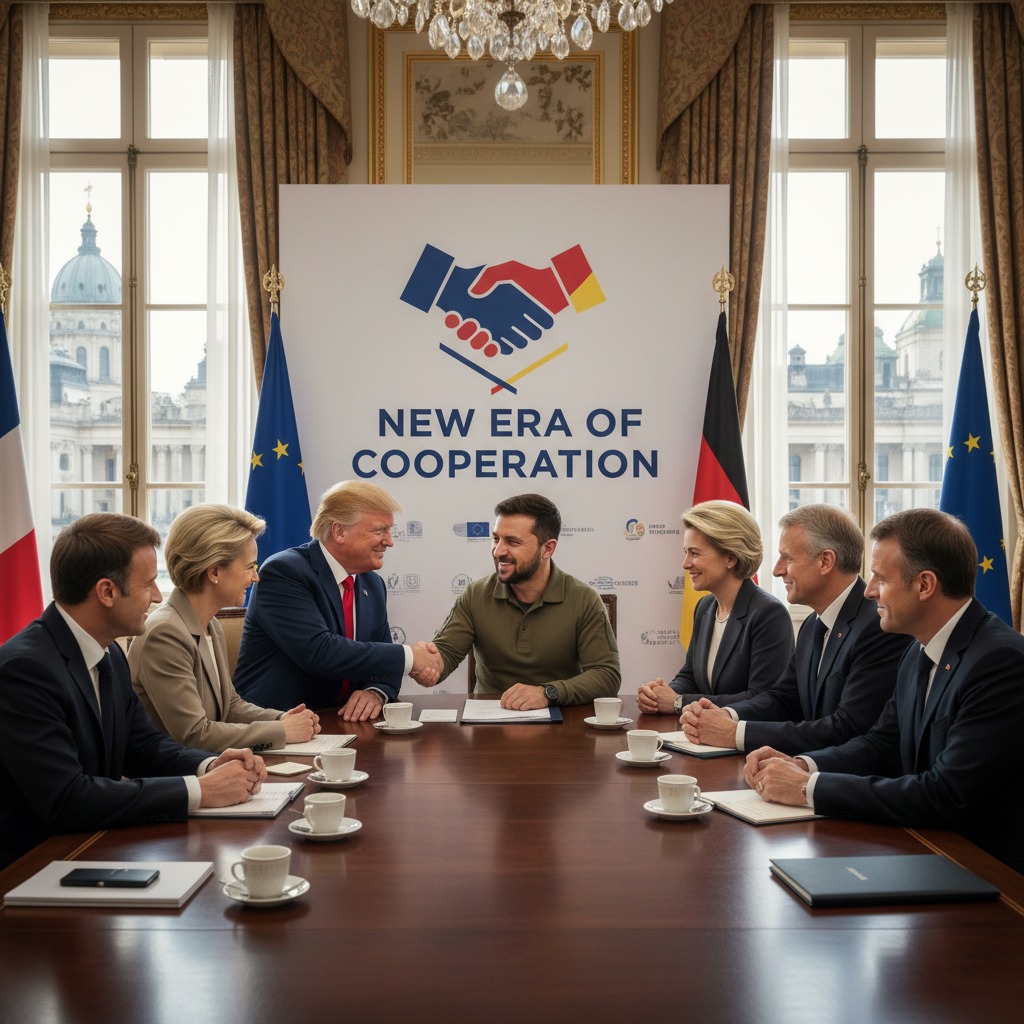
While the latest talks held Monday between Trump, Ukrainian President Volodymyr Zelensky and the leaders of the Finland, France, Germany, Italy, the United Kingdom, the European Union and NATO did not produce an agreement to end the three-and-a-half-year war, the gathering laid the groundwork for a long-anticipated trilateral meeting between Trump, Zelensky and Russian President Vladimir Putin, with whom Trump met in Alaska on Friday.
Perhaps most notably, however, the U.S. leader did not walk back from the position of Ukraine needing to offer territorial concessions as part of an eventual settlement, a stance long opposed by Kyiv and its European backers.
“We also need to discuss the possible exchanges of territory, taking into consideration the current line of contact,” Trump said during a press engagement alongside Zelensky and European counterparts.
With Ukraine currently not in control over substantial amounts of Russian territory, its limited cross-border offensives having largely been pulled back earlier this year, Jennifer Kavanagh, senior fellow and director of military analysis at the Defense Priorities think tank, said the comments were indicative of a broader reality that has set in over the conflict.
“Ukraine will have to cede some territory to end the war, the question is how much and how,” Kavanagh told Newsweek. “At the very least, it will not go back to its pre-2022 borders. Crimea will not be returned to Ukraine.
“Ukraine can choose to keep fighting now rather than settle for Putin’s terms that require withdrawing from the Donbas, but they are losing territory at a more rapid rate and their frontlines are overstretched,” Kavanagh said. “More time may not buy them a better deal but force them to settle for much less.”
Zelensky has long expressed an unwillingness to cede land to Russia but expressed his openness earlier Monday to discussing territorial control “where the front line is now.” Russian forces currently occupy all of Crimea, nearly the entirety of Luhansk and approximately three-quarters of Donetsk, Kherson and Zaporizhzhia.
The nearly 20 percent of Ukrainian territory held by the Russian military was on full display on a map stood in the Oval Office on Monday as Trump and Zelensky spoke in front of the press ahead of their discussions.
Trump has expressed confidence on the possibility of a joint meeting with Putin and Zelensky. Zelensky has also expressed openness to the idea, while the Kremlin has said Putin would only meet his Ukrainian counterpart following “preparatory work at the expert level.”
So far, the results of Trump’s direct meetings with Putin and Zelensky, alongside European allies, have yet to achieve a breakthrough, though they may pave the way for further discussions on issues Rahman said would need to be addressed even before a settlement on top-line items like territorial control and security guarantees.